Can a victory in Le Mans enhance your Toyota Yaris?

- Published on 17/06/2026 7:28
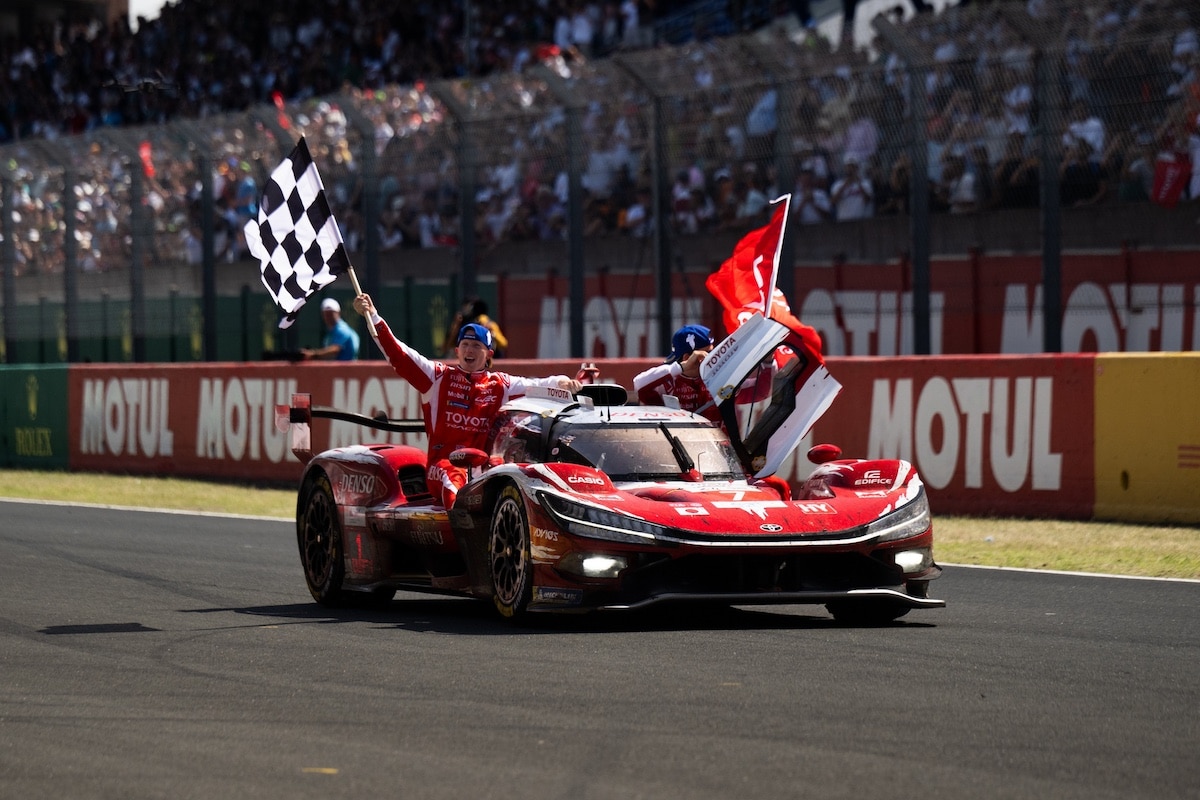
When a Toyota triumphs at the 24 Hours of Le Mans, it is legitimate to wonder if this success improves production cars.
Indeed, what is the connection between a Hypercar prototype with over 700 hp launched at more than 350 km/h on the Hunaudières straight and a modest Yaris used every day for commuting? The answer is clear: much more than one might think.
Long considered merely a marketing tool, motorsport has regained its historical role as a technological laboratory in recent years. At Toyota, this heritage is even claimed. The Japanese manufacturer explains that it uses the World Endurance Championship to push the boundaries of its hybrid powertrains and improve its understanding of this technology to develop better production cars.
The Hybrid Cousins
The link is perhaps most evident in hybridization. A Hypercar entered at Le Mans must recover energy during braking, store it, release it as efficiently as possible, and manage its temperature over 24 hours of racing. These extreme constraints allow for quicker development of solutions that are then found, in an adapted form, in widely distributed hybrid models like the Yaris or the C-HR.
But technological transfers do not stop there. The composite materials used in prototypes serve as a testing ground to lighten vehicles while improving their rigidity. Advances made in lighting systems, aerodynamics, and thermal management also find concrete applications in road models.
More recently, the digital revolution has opened a new field of innovation. Manufacturers now use advanced simulation tools, powered by artificial intelligence and massive amounts of data, to develop cars, engines, and software more rapidly. The lessons learned from competition then permeate the entire range.
Even the tires illustrate this dynamic. In Endurance, the current Michelin tires can last through up to four stints, equating to more than 40 laps of the Le Mans grand circuit and over 540 kilometers at very high speeds. In comparison, some Formula 1 tires are sometimes replaced after just five or six laps on a track of around five kilometers. This ongoing quest for longevity, energy efficiency, and consistency is of direct interest to manufacturers for their production products.
You might be interestedin this article:
Of course, a Le Mans Hypercar will never become a Yaris. The regulatory, economic, and industrial constraints are radically different. But competition remains a powerful accelerator of innovation. By pushing technologies to their limits for 24 hours, it opens an almost infinite realm of possibilities. And that is precisely why a victory at Le Mans can, indirectly, improve the car parked in front of your house.
READ ALSO: Toyota unveils its Liquid Hydrogen Hypercar
This page is translated from the original post "Une victoire au Mans peut-elle améliorer votre Toyota Yaris ?" in French.
We also suggestthese articles:
Also read
Recent articles