Renault Integrates Gemini into Its Cars: How Google’s AI Will Transform Driving

- Published on 30/06/2026 11:18
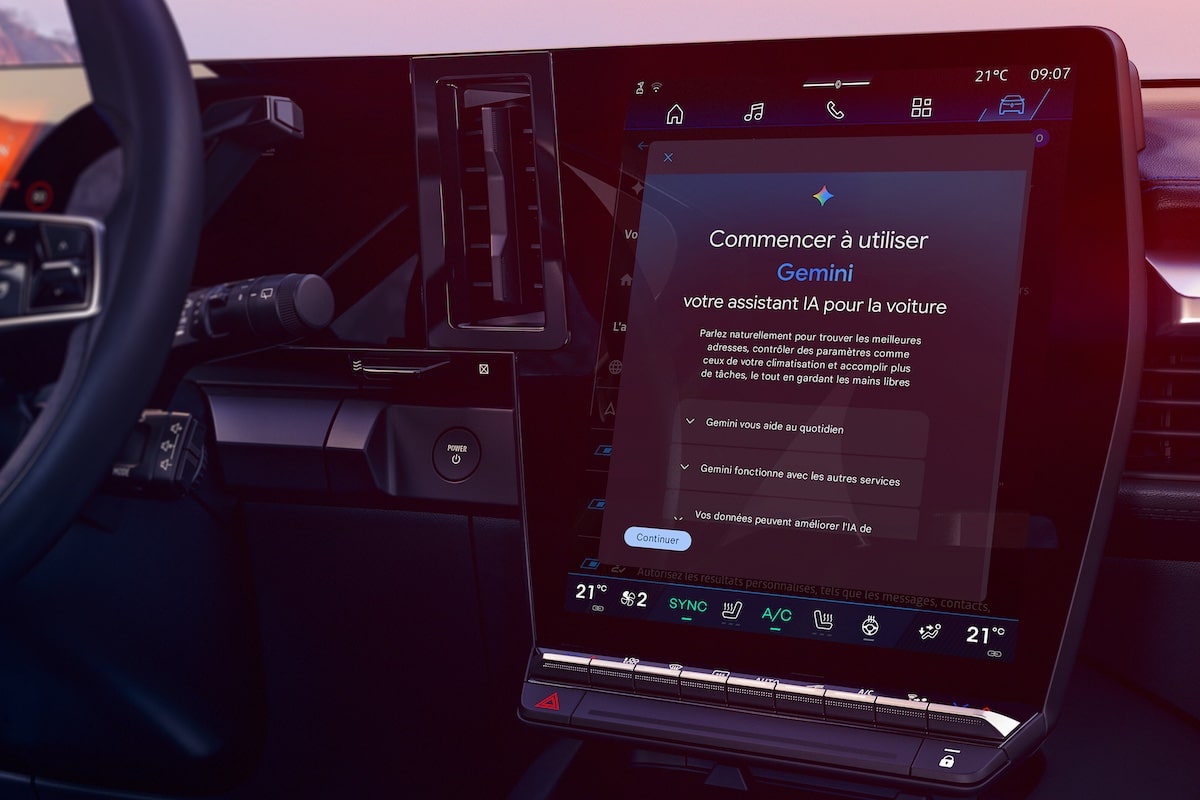
Renault deploys Google’s Gemini in its vehicles equipped with openR link. Operation, new features, and the impact of this embedded AI for drivers.
Gradually rolled out since June 15 via an over-the-air update, the integration of Gemini into the openR link multimedia system is progressively replacing Google Assistant in compatible Renault models. This change affects vehicles equipped with integrated Google and does not require a workshop visit. Users will simply need to activate the feature from their Google account, with the manufacturer also allowing the option to retain or reactivate Google Assistant.
Technically, this change goes beyond a simple voice assistant switch. Gemini is based on a generative artificial intelligence model (Large Language Model or LLM), capable of interpreting queries posed in natural language instead of waiting for precise commands. Where a traditional voice assistant primarily responds to predefined instructions such as, “call,” “navigate to,” “set the temperature,” Gemini is designed to understand the context of a conversation, interpret the user’s intention, and handle multiple requests within a single exchange.
In practical terms, the driver can make a complex request without having to break it down into several commands. It thus becomes possible to request a route meeting multiple criteria, simultaneously adjust various vehicle settings, or obtain general information while continuing the conversation, without having to repeatedly use the activation keyword.
A more advanced integration than on Android Auto
One of the main differences with Gemini used via Android Auto lies in its level of integration into the vehicle. In openR link, the assistant can directly access the car’s native functions: navigation with Google Maps, climate control, audio system, comfort settings, or specific data for electric models, such as remaining range or battery charge status.
This connection to the vehicle’s systems allows, for example, to adapt a journey based on available range or to manage multiple functions with a single voice command. Renault also plans to soon introduce Gemini Live, an even more conversational version that will allow the assistant to be interrupted during its response, to carry out multiple requests without repeating “Hey Google,” or even to change language during the same conversation.
Toward a new human-machine interface
Beyond the new features, this evolution illustrates a fundamental trend in the automotive industry: the transformation of the human-machine interface. After connecting vehicles to smartphones and then to online services, manufacturers are now betting on generative artificial intelligence to simplify interactions with embedded systems.
The stated goal is also to limit touch screen interactions, which have become one of the main points of criticism for modern cars over the years. A voice interface capable of understanding naturally phrased requests could reduce the time spent navigating menus and allow the driver to maintain greater focus on the road.
You might be interestedin this article:
Like the entire openR link system, Gemini will continue to evolve through over-the-air updates. New languages, features, and capabilities will be gradually added, confirming a significant evolution in automobiles: a car whose digital performance can continue to improve throughout its lifespan, without hardware modifications.
READ ALSO: Pierre Niney and Pierre Gasly unveil a unique Alpine Lacoste!
This page is translated from the original post "Renault intègre Gemini dans ses voitures : comment l’IA de Google va transformer la conduite" in French.
We also suggestthese articles:
Also read

Recent articles