The Ferrari Luce Knocked Out by the Mercedes-AMG GT Coupe!

- Published on 29/05/2026 10:24
- Modified on 29/05/2026 19:37
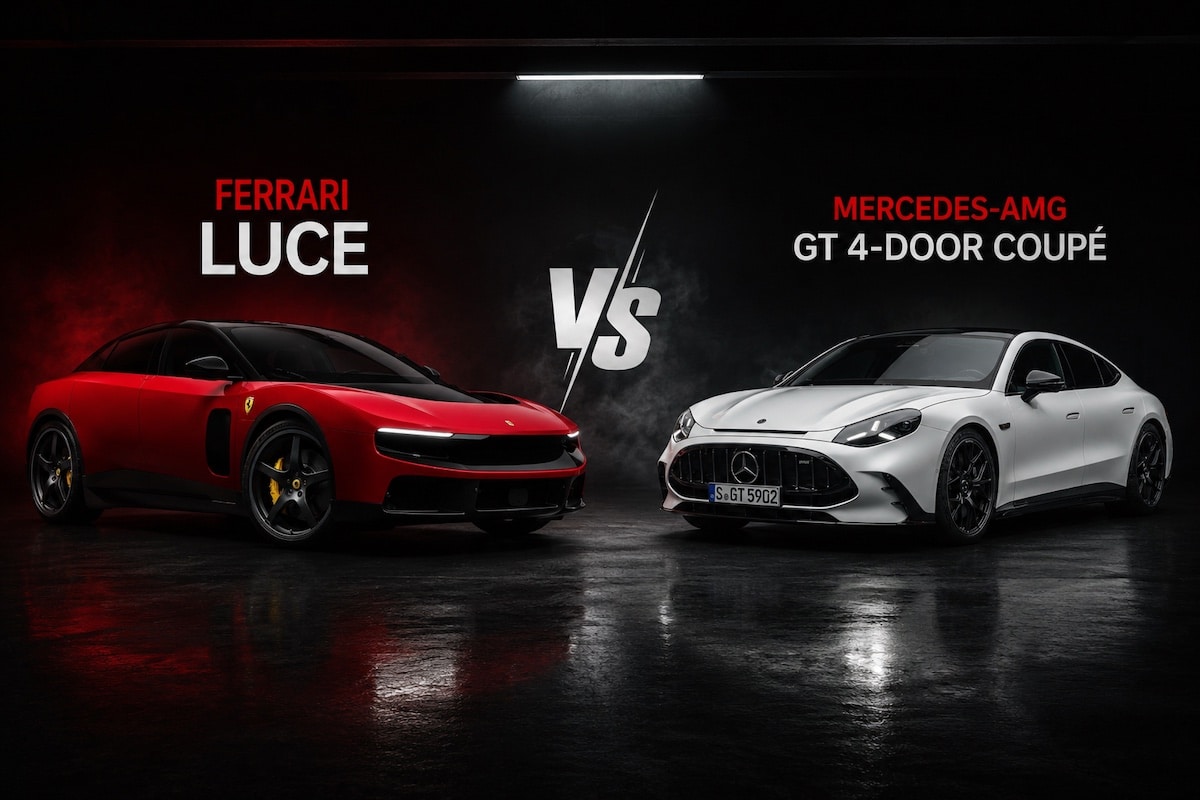
No false suspense, just a reality. When Ferrari missteps, Mercedes embraces the future without renouncing its identity.
The first electric Ferrari was awaited as a historic event. It could ultimately become one of the largest sources of debate in the history of Maranello. In contrast, and presented just a few hours earlier, the new Mercedes-AMG GT 4-Door Coupe electric represents a radically different approach to the energy transition. And from the very first glance, the gap is striking.
Mercedes has perfectly understood what constitutes the strength of a centenary brand. Despite abandoning V engines, the 4-Door GT remains instantly identifiable as an AMG. Its immense hood, generous fenders, low silhouette, and aggressive posture perpetuate the stylistic codes that have built the reputation of Stuttgart’s sports division. And what can be said of the grille? The car is modern but remains a Mercedes-AMG.
The Ferrari Luce takes the opposite path. Designed under the influence of Jony Ive’s LoveFrom studio, the former head of Apple’s design, it adopts a minimalist, almost clinical aesthetic. The lines are stripped to the extreme, the surfaces simplified, and the details reduced to a minimum. The result is undeniably original but raises a fundamental question: is it a Ferrari?


Unlike an F80, a 296, an Amalfi, or even a Purosangue, the Luce does not remind one of any iconic model from the history of Maranello. Even the recent 849 Testarossa honors its prestigious surname. The Luce does not extend a legacy; it attempts to create a new one. While Mercedes fully embraces its transition to electric by keeping all the markers of its DNA, Ferrari seems almost ashamed of it. By developing a specific visual identity, detached from its thermal models, the Italian manufacturer gives the impression of viewing the electric as a parallel activity rather than as the unexpected yet natural continuation of its history.
High-Level Performances
On a technical level, Ferrari has not spared any expenses. The Luce claims more than 1,000 horsepower thanks to four electric motors, one for each wheel. Its 800-volt electric architecture powers a 122 kWh battery capable of delivering more than 530 kilometers of range according to the WLTP cycle.
The announced performances are impressive: 0 to 100 km/h in 2.5 seconds and over 310 km/h in top speed. Ferrari also promises fast charging that can reach 350 kW, allowing a significant portion of the battery capacity to be recovered in about twenty minutes.
A spectacular Ferrari… and the Mercedes takes the stage.
Originating from the AMG GT XX program, the future electric 4-Door GT promises up to 1,360 horsepower in its most extreme version. Even the announced production variants would already exceed 1,100 horsepower.
But it is especially in charging that Mercedes is widening the gap. Thanks to a new generation of directly cooled cylindrical cells and a particularly advanced electric architecture, the German brand announces charging powers exceeding 850 kW. The result is spectacular: up to 400 kilometers of range recovered in just five minutes under optimal conditions. No major automotive manufacturer today can boast such a level of performance.
More than just the figures, Mercedes has designed its car as a true electric vehicle by emphasizing enormous torque and driving comfort. Ferrari, on its side, is still trying to artificially replicate certain sensations of the combustion engine through synthetic sounds or specific vibrations.


And what can be said about the interior… A screen barely larger than an iPad for the Ferrari and a three-spoke Sim Racing steering wheel. A screen covering the entire width of the dashboard and an abundance of luxury materials for the Mercedes-AMG! Switching from the driver’s seat of a Mercedes to that of a Ferrari becomes a punishment.
The Price That Changes Everything
This is probably where the comparison becomes the most difficult for Ferrari. The Luce should be marketed around 550,000 euros. A price in line with Maranello’s habits but which immediately places the model in an extremely exclusive sphere. In contrast, the Mercedes-AMG GT 4-Door electric is expected to start around 155,000 euros in its entry-level version and reach about 200,000 euros for the highest-performing variants.
In other words, a Mercedes offering comparable, if not superior, performance in certain key areas would cost nearly three times less than the Ferrari! The Ferrari Luce is certainly not a bad car. Its technical specifications impress, and its level of performance promises to be exceptional. But a Ferrari is not supposed to be just an assembly of figures and technologies. It must evoke immediate emotion, prolong a legacy, and embody a story.
The Luce Fails
Mercedes-AMG demonstrates that it is possible to fully embrace the electric era while remaining true to its identity. Ferrari, on the contrary, seems to have chosen complete break. The result is a technologically remarkable car but emotionally disconnected from what made the brand great.
The first electric Ferrari does not resemble the Ferrari of the future. It resembles a Ferrari that no longer really knows what it is.
You might be interestedin this article:
READ ALSO: What is Ferrari playing at with the electric Luce?
This page is translated from the original post "La Ferrari Luce mise KO par la Mercedes-AMG GT Coupé !" in French.
We also suggestthese articles:
Also read