The first motorcycle in history had four wheels… and 0.5 hp!

- Published on 29/08/2026 12:58
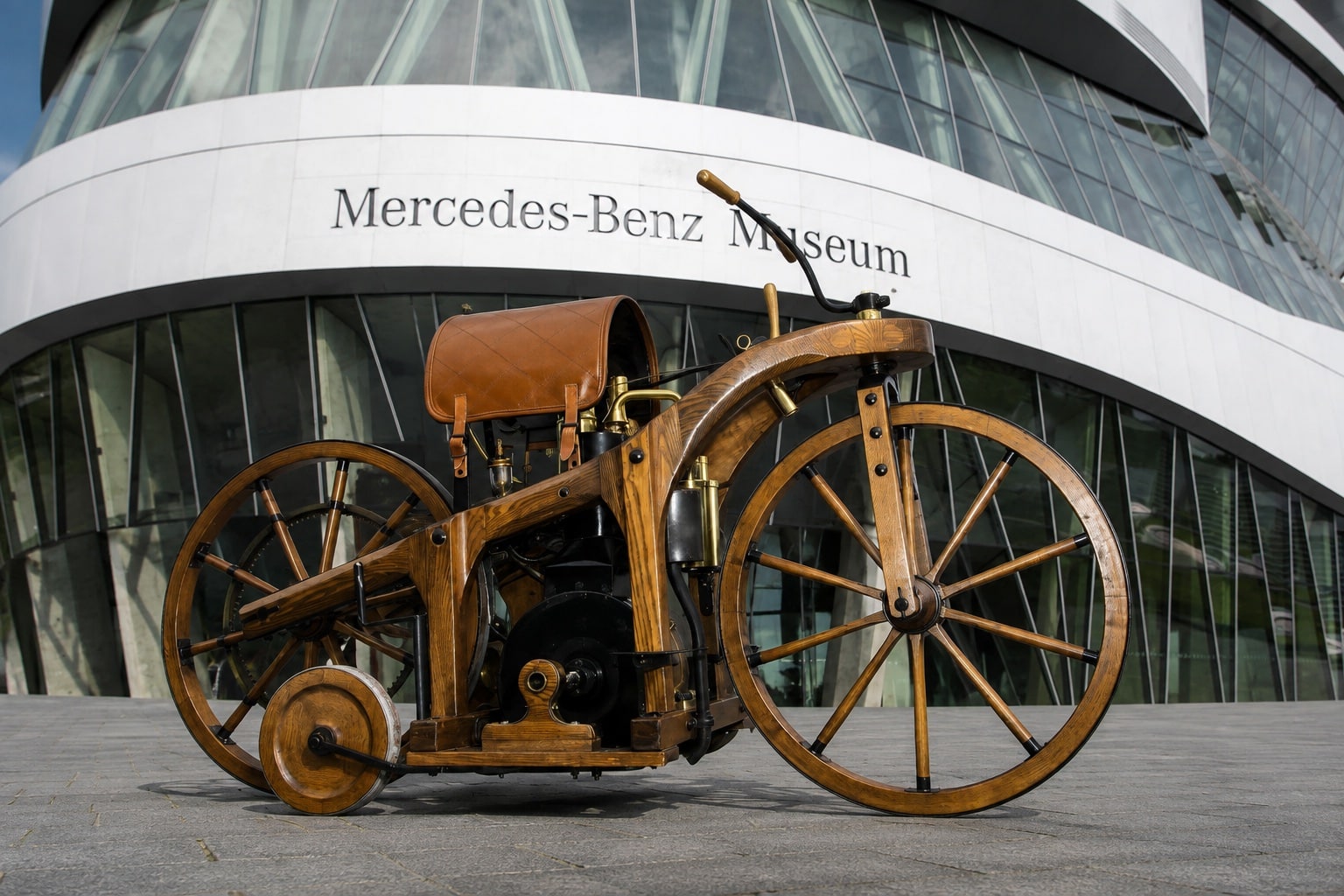
On August 29, 1885, Gottlieb Daimler filed a patent for the Reitwagen, considered one of the ancestors of the gasoline-powered motorcycle. A peculiar machine with 0.5 hp that had… four wheels!
Forget about motorcycles with 200 hp, TFT screens, and electronic aids. To discover the origins of the modern motorcycle, we need to go back 141 years. On August 29, 1885, German engineer Gottlieb Daimler patented the Reitwagen, literally meaning “riding vehicle.”
Designed with Wilhelm Maybach, the contraption looks nothing like a modern motorcycle. Its frame is made of wood, as are its two large wheels, which are simply rimmed in metal. And importantly, two small side wheels are responsible for preventing the rider and machine from tipping over.
The Reitwagen, first gasoline-powered motorcycle?
This is why this first motorcycle in history had four wheels! A peculiarity that still fuels discussions about its exact status. But the Reitwagen remains a major milestone in the history of motorized two-wheelers.
Indeed, beneath its seat lies the essential part: a 264 cm³ single-cylinder four-stroke engine developed by Daimler and Maybach. It delivers about 0.5 hp and allows for a speed of around 12 km/h. Not exactly enough to set off a radar.
Just a few months later, Paul Daimler, Gottlieb’s son, undertakes a trial ride with the machine between Cannstatt and Untertürkheim, near Stuttgart. The goal is primarily to demonstrate that a small gasoline engine can propel a vehicle independently.
The Daimler Reitwagen would never have a commercial career. But the principle is established. Today, some motorcycles exceed 300 km/h. And, in 141 years, they have thankfully learned to do without training wheels.
You might be interestedin this article:
This page is translated from the original post "La première moto de l’histoire avait quatre roues… et 0,5 ch !" in French.
We also suggestthese articles:
Also read
Recent articles