LEZ: The Failure of the Method, Not the Principle

- Published on 16/04/2026 13:08
Seen as a key tool for ecological transition, Low Emission Zones (LEZ) have faced chaotic and widely contested implementation.
Presented as a major lever for ecological transition in urban areas, Low Emission Zones (LEZ) were supposed to sustainably transform mobility in major French cities. However, their rollout quickly became a case study of poorly calibrated public policy. The initial ambition ran into a much more complex social, technical, and political reality.
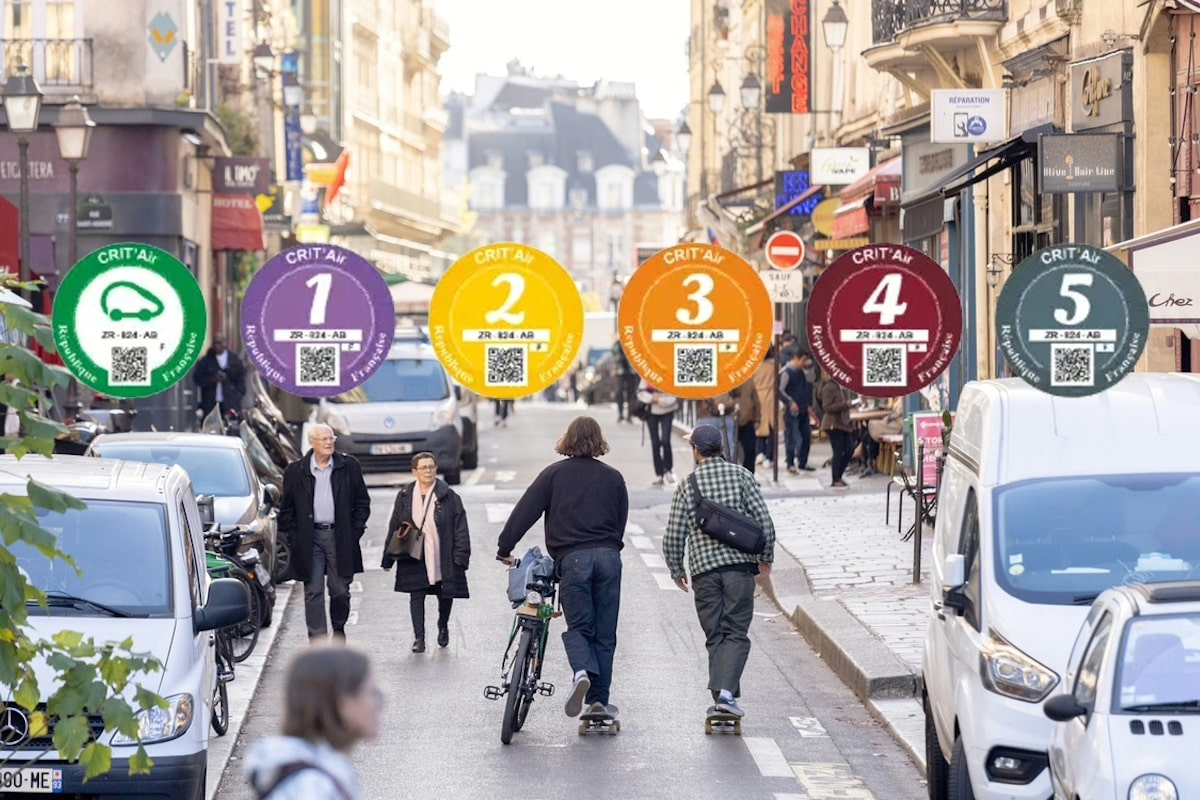
From their generalization, LEZ suffered from a structural flaw: a uniform logic applied to vastly different territories. Between Paris, Lyon or Grenoble and the small and medium-sized urban areas integrated into the scheme, the capacity for adaptation varies greatly. Nevertheless, the rules were applied with increasing rigidity, imposing traffic restrictions based on technical criteria (Crit’Air stickers) often misunderstood or deemed arbitrary by some users.
We must not impose virtue
The second factor in the failure relates to social acceptability. A policy that directly affects low-income households and workers reliant on their vehicles cannot function without massive support. However, LEZ have been perceived as a constraint imposed from above, with insufficiently credible alternatives in many areas. This fracture has fueled a diffuse yet persistent dissent. Moreover, this obstinacy has turned the issue into a symbol of the gap between national decisions and ground realities.
Finally, the governance of the scheme has lacked clarity. Adjusted timelines, altered boundaries, and successive exemptions. Instead of reinforcing trust, these changes have given the impression of an unstable, sometimes improvised system. This sense of inconsistency has weakened the entire project.
You might be interestedin this article:
Ultimately, LEZ illustrate not so much a failure of principle as a failure of method. The environmental goal remains widely shared, but its operational translation, too rapid and insufficiently consulted, has led to a flawed scheme. Add specific signage, successive communication campaigns, and the remuneration of various actors involved in the rollout… This has resulted in millions of euros of public resources being wasted. Sad and disappointing.
This page is translated from the original post "ZFE : le fiasco de la méthode, pas du principe" in French.
We also suggestthese articles:
Also read