Why Fashion Has Become the New Driver of Motorsport

- Published on 23/07/2026 13:28
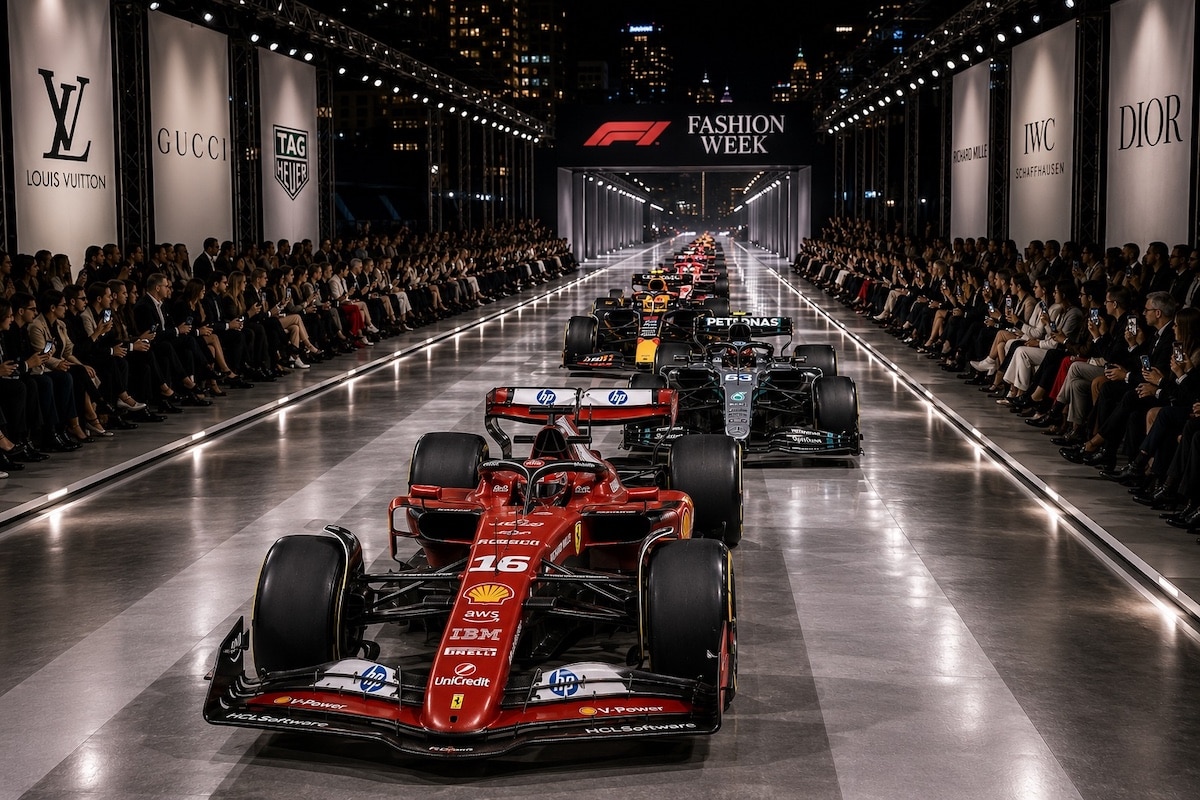
By becoming more virtuous and more desirable, motorsport is now one of the favorite playgrounds of the greatest luxury houses.
From the podiums of Fashion Week to the paddocks of Formula 1, the boundaries have never been so porous. For decades, motorsport primarily sold performance. Manufacturers spoke of horsepower, engineers of aerodynamics, and drivers of hundredths of seconds. The paddocks were workshops where one breathed more of the essence than the fragrance of great fashion houses. Fashion and luxury observed this world with interest, but without truly identifying with it.
A Past Era
Today, motorsport grooms its image with the same care that a great couturier prepares a fashion show. The liveries are as polished as graphic artworks, the paddock hospitality resembles private lounges, and collaborations with designers, artists, or fashion creators are multiplying. You can even now find luxury boutiques in the aisles of the racetracks! More than a sporting discipline, Formula 1 has become a global cultural stage.
This revolution is far from trivial. It accompanies a profound transformation of the image of competitive automobiles. Long criticized for its fuel consumption, noise, or environmental impact, motorsport now displays a much more responsible face. Formula E has built its entire identity around electric mobility. The World Endurance Championship runs on renewable fuels, prepares for the arrival of hydrogen at Le Mans, and claims its historic role as a technological laboratory. Formula 1, for its part, is about to take a major step forward with the introduction of 100% sustainable fuels. Without becoming flawless, the discipline no longer embodies only speed: it now claims innovation.
This new respectability naturally opens the doors to partners who, just yesterday, seemed very distant from the racetracks. Since the partnership between Formula 1 and LVMH, Louis Vuitton has been omnipresent at the Grands Prix. The famous trunks transporting the trophies have become an essential element of the ceremonies, just like champagne. Starting in 2027, Gucci will join Alpine F1, further proof that fashion houses now see the paddocks as one of the planet’s most powerful showcases. The phenomenon is also extending far beyond fashion. Major watchmakers are making a notable comeback. TAG Heuer has returned as the official timekeeper of Formula 1, alongside Rolex, Richard Mille, Tudor, and H. Moser & Cie, which are multiplying partnerships with championships, teams, and drivers.
Why such enthusiasm? Because the public has profoundly changed. Thanks to social media, Drive to Survive, and much more modern communication, motorsport today attracts a younger, more female, and more international audience. A generation that no longer simply follows a race but subscribes to a universe. They want to wear Lewis Hamilton’s oversized jacket, Lando Norris’s neon cap, the watch given to the winners of the 24 Hours of Le Mans, or even Charles Leclerc’s sunglasses when it’s not his little dog… They consume style as much as performance.
I have, therefore I am
Drivers have become the best ambassadors of this transformation. Hamilton paved the way by making Fashion Weeks a natural expression ground as the circuits. Charles Leclerc, Pierre Gasly, Carlos Sainz, or George Russell also cultivate an extremely crafted image, alternating advertising campaigns, magazine covers, and collaborations with the biggest houses. They are no longer just champions. They have become trendsetters, capable of influencing the fashion tastes of millions of young fans worldwide.
This ability to inspire dreams is precisely what attracts major brands today. Luxury houses are not just seeking a few seconds of visibility on a car’s body. They invest in an imaginary. One of speed, excellence, innovation, but also a lifestyle that an entire generation aspires to.
You might be interestedin this article:
Because one rule has never changed: in motorsport, as in all great spectacles, money calls money. And when this money is adorned with a beautiful golden patina, a prestigious monogram, or a few diamonds artfully displayed, no one really complains. Brands find a showcase worthy of their image, championships bolster their attractiveness, and teams have new means to continue pushing the limits of technology. In the end, speed is no longer the only luxury of motorsport: its image has also become a safe haven value.
READ ALSO: F1 continues its ecological shift
Visual generated by AI
This page is translated from the original post "Pourquoi la mode est devenue le nouveau moteur du sport automobile" in French.
We also suggestthese articles:
Also read
Recent articles